

Our Wikipedia, material: 3D printing
See also: Construction of a statuette | 3D printed statuette gallery
3d print
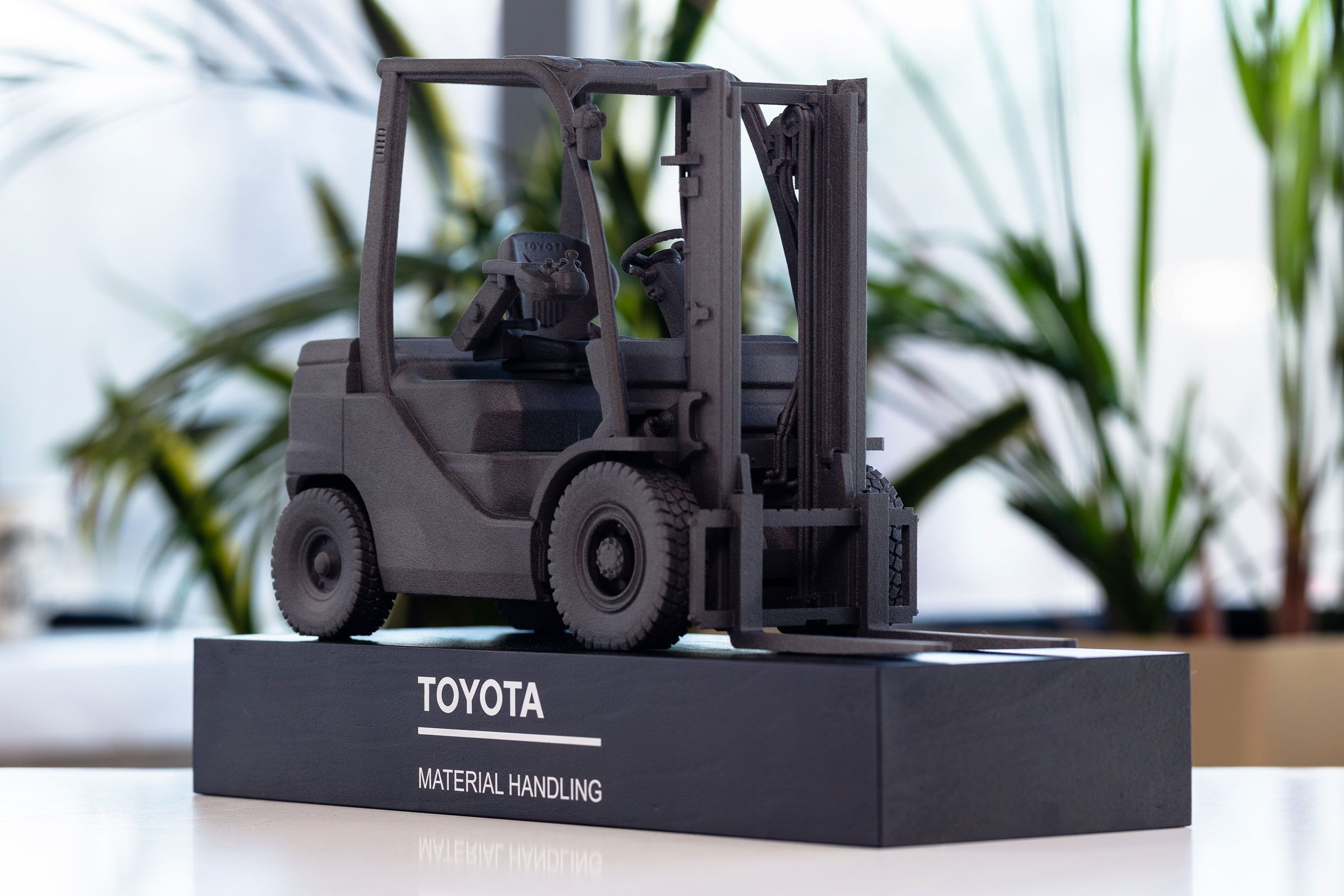
3D printing technology allows for the creation of any complex elements and figurines. With it, we can transfer a virtual three-dimensional design directly into the real world.
3D printing is also used for prototyping serial production (this way, we can test a detail, such as its size, without having to start the entire production process) and for creating molds for the final production (after appropriate processing, the object serves as a template from which we make an accurate form for casting).
We also use this technology to produce final elements (whether components or entire statuettes). However, this usually occurs in small-scale projects, where creating casting molds, for example, would be uneconomical.
Depending on the client's needs and the chosen technology, the produced elements undergo several technological processes (such as surface smoothing, painting, or chrome plating).
In general, 3D printing technology involves depositing successive very thin layers of material, one on top of the other. These layers build the statuette from the bottom up.
Nowadays, there are many 3D printing technologies, some differing in minor details (depending on the printer manufacturer). The basic ones include:
Nowadays, there are many 3D printing technologies, some differing in minor details (depending on the printer manufacturer). The basic ones include:
SLA
SLA printing is produced from liquid resin. Successive layers of the print are created by sintering them using a laser with a specific wavelength.
The printer's tray is placed at the edge of the resin surface located in the printer's chamber. At this point, the laser sinters a layer of resin that adheres to the tray. After a layer is completed, the tray moves upward, and the laser sinters another portion of resin, attaching it to the previous layer.
This is a high-resolution technology that works well for creating models for even small casting molds.
SLS i DMLS
SLS printing uses plastic powder (and metal powder in DMLS printing). The powder is sintered using a laser.
The powder is placed in the printer's chamber. On its surface (leveled with a special arm), the laser creates the first layer, after which the chamber is lowered by the thickness of one print layer. The arm evens out and levels the surface again, and the laser sinters the next layer. The process is repeated until the full print is completed.
The advantages of this technology include its high resolution and the lack of need for support structures, which makes it easy to produce geometrically complex prints.
DMLS printing, due to the use of metal powder, is characterized by the highest strength among available 3D printing technologies. The advantage is the choice of available metals, including precious metals. However, this technology is also very expensive.
FDM
This technology involves laying thermoplastic on the printer's bed, which is fed into the printer's head in the form of a filament (a wire made of plastic). It is then heated and placed in a molten form on the platform, layer by layer. After each subsequent layer, the printer bed or head (depending on the device) is moved in the X-axis. The successive heated layers are fused together by melting.
This type of printing has relatively low accuracy and resolution, which is why it is more often used for prototyping larger elements.
MJP
MJP printers, in a simplified way, resemble standard inkjet printers. The material (photopolymer) is deposited on the printer bed in a thin layer by the printing head and then cured with UV light. This way, a print layer is created. Then, the working platform is lowered, and the printing head applies the next layer of the print.
In the case of MJP printing, an additional support material is needed. It is a resin fed from a separate head, which is ultimately removed using water.
Similarly to SLS printing, we do not have standard supports here, which allows for printing complex and intricate figures. The advantage is also undoubtedly high accuracy and surface quality.
CJP
This 3D printing technology combines a bit of SLS and MJP printing. Powder is used to create figures, spread in a chamber similar to SLS printing. However, successive print layers are bonded together using a binder applied between the layers (the shape of the binder defines the shape of the layer). The binder is applied through a head similar to inkjet printers. Importantly, it can be colored, allowing for color prints.
The advantages of CJP are speed and low cost of creating prints. The lack of technological supports and the ability to print in color allows for creating elements that are not available with other technologies.